It's a good day. Trains are running well on the Paducah Switching layout, thanks to Ron Schlueter who came over this afternoon and worked his magic on fixing a problematic curve (too tight and with a kink) and generally tuned the track. I was most pleased Ron was able to fix the curve without widening it to the point where I might have to change the track plan in that area.
Wednesday, March 18, 2020
Trains running well ... yippee!

Tuesday, March 10, 2020
Trains are running ... kinda ...
Trains are running on the Paducah Switching ... kinda. The roadbed is down, and the track is weathered and down. Under the bench buss wires are in (courtesy Kent Tallyn), and most of the drops are in (with help from Kent, Ron Schlueter, and Bill Levin).
The drops that are in are attached to the buss wires (again, Kent and Bill Levin). Bill Buhr and Dale DeWitt laid down the last of the track and "tuned" some of my efforts. Hank Kraichely weathered the ties.
Today, I started cleaning the weathering residue from the track with a very fine grit sandpaper. The manufacturer of the weathering solution says the track will conduct electricity after it has dried; ain't so! I, and others, have found the track needs to be cleaned of the residue. Anyway, after my initial cleaning effort, two of the engines I plan to use -- the 2-8-0 Consolidation and one of the RS-3's, both ran pretty well. I determined several areas that still need drops, and some places that will require additional cleaning. There are also a couple of spots where the track work needs to be addressed. Right now, progress is maddeningly slow, but if the track work isn't good, and the trains don't run well, nothing else much matters. We'll stay after it.
 |
| Ron Schlueter solders the drops |
Today, I started cleaning the weathering residue from the track with a very fine grit sandpaper. The manufacturer of the weathering solution says the track will conduct electricity after it has dried; ain't so! I, and others, have found the track needs to be cleaned of the residue. Anyway, after my initial cleaning effort, two of the engines I plan to use -- the 2-8-0 Consolidation and one of the RS-3's, both ran pretty well. I determined several areas that still need drops, and some places that will require additional cleaning. There are also a couple of spots where the track work needs to be addressed. Right now, progress is maddeningly slow, but if the track work isn't good, and the trains don't run well, nothing else much matters. We'll stay after it.
Sunday, March 1, 2020
Slow, but sure
Fellow Gandy Dancers (our Thursday night round robin group) are providing extra hands and much needed expertise in getting the P&LE running. As in many things, it's taking longer than hoped, but it is being done extremely well.
Thursday night, much of the gang was here. Kent Tallyn did the under-the-bench wiring, running the buss wires and hooking up the drops from the tracks via 3M Scotchlock "suitcase" connectors. Bill Levin and Tom Gaffuri were soldering the drops to the tracks; Bill Buhr worked on a turnout connection that was causing a kink; and Hank Kraichely spent the evening weathering the ties.
Sunday, Bill Buhr returned and worked on two additional turnouts. He also brought his test car to run through its paces to see that the track was running smoothly.
Next to be completed are two short pieces of track to be put down, the remainder of the drops to be soldered to the track and then attached to the buss wires, and the NCE control system installed. The plan is that assuming I can get some of it down between now and Thursday, the group can get the rest done Thursday night. The beat goes on.
 |
| Bill Levin (l) and Kent Tallyn (r) taking a break from adding drops from the track to the buss wires. |
Sunday, Bill Buhr returned and worked on two additional turnouts. He also brought his test car to run through its paces to see that the track was running smoothly.
 |
| Bill Buhr with his track test car that he constructed. It works well. |
Monday, February 24, 2020
Track is weathered, ready to put down
 |
| This is the rail before weathering |
 |
| After weathering; I wish it all looked like this |
 |
| Track ready to be placed in the solution |
Tuesday, February 18, 2020
Road bed is down, ready for track
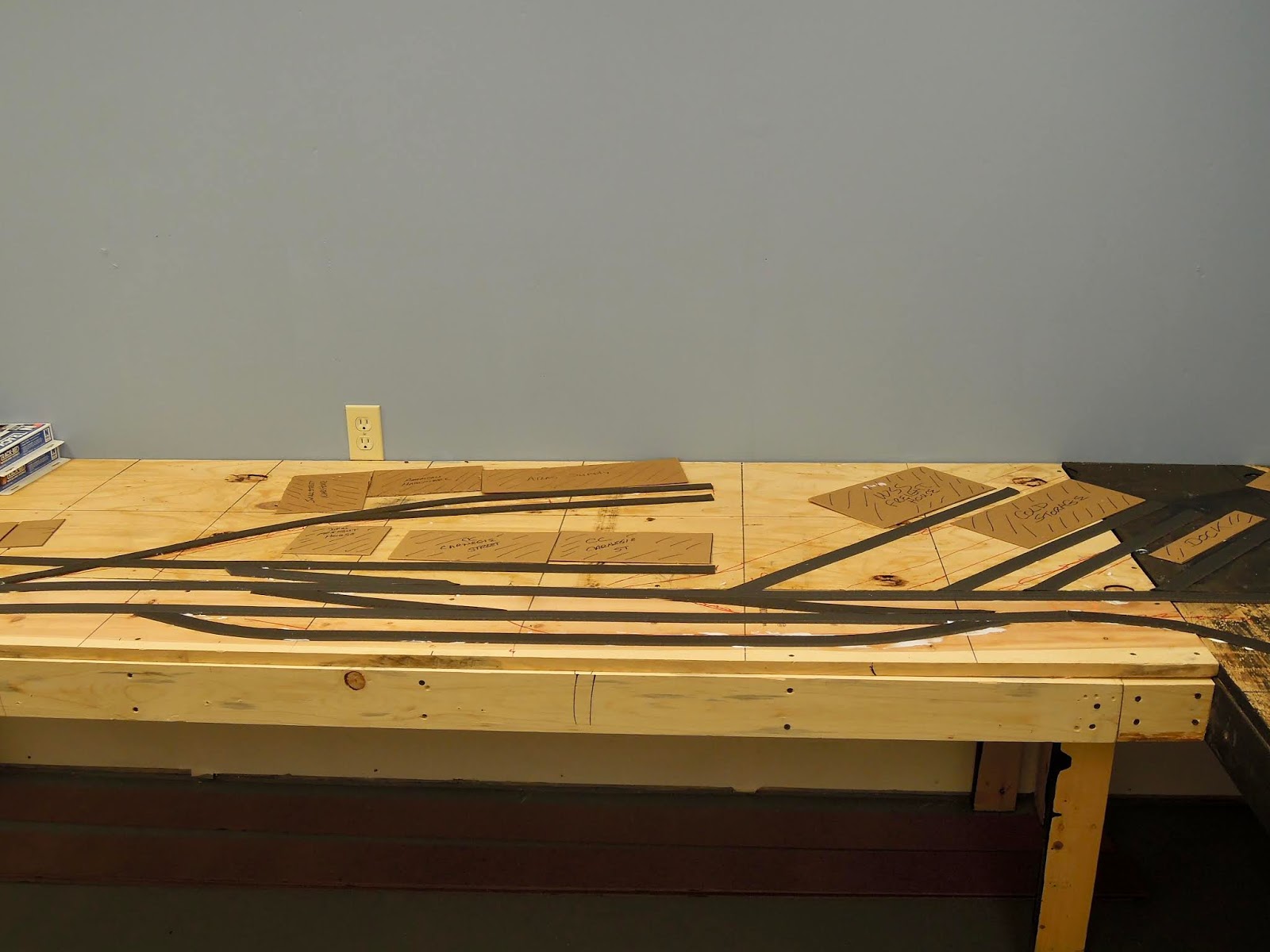
The road bed is down, ready for track. Although I model, as you know, in HO scale, I am using N-scale road bed, which is a lower profile at 3 mm than HO at 5 mm.
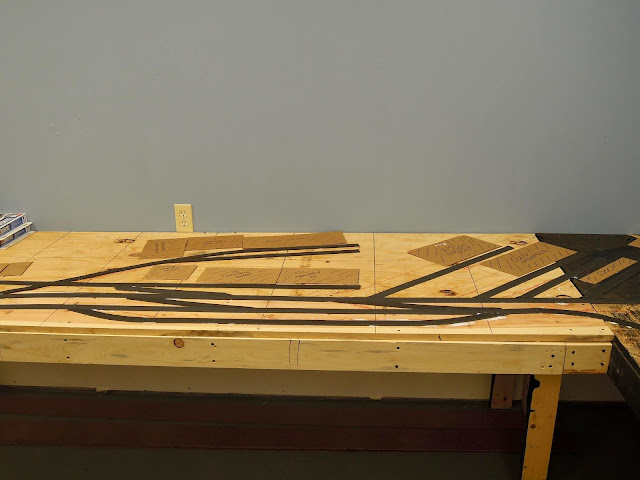

Next comes the track, but first it has to be weathered. I am using the Micro-Engineering weathering solution. The process is mixing the solution with water and then immersing the track for a specified period. I'm going to start with a 2:1 water-to-solution mixture and a 3-4 minute immersion. I will continue to check the track until I get the level of weathering I want.
I have been avoiding this piece of the project, but its time to bite the bullet. Good friend and great modeler Dave Abeles (Onondaga Cutoff at https://onondagacutoff.blogspot.com) recently wrote in his blog about the intimidation of tasks untried hindering progress, and the need to just move forward and do it. It hit home with me. Interesting that both projects - his creating a pond, and me weathering in a liquid solution - involved water.
My next post will be a report of how (successfully, I hope) the weathering worked out complete with photos.

I have been avoiding this piece of the project, but its time to bite the bullet. Good friend and great modeler Dave Abeles (Onondaga Cutoff at https://onondagacutoff.blogspot.com) recently wrote in his blog about the intimidation of tasks untried hindering progress, and the need to just move forward and do it. It hit home with me. Interesting that both projects - his creating a pond, and me weathering in a liquid solution - involved water.
My next post will be a report of how (successfully, I hope) the weathering worked out complete with photos.
Monday, February 17, 2020
Ready for roadbed
In the previous post, I drew one-foot squares on the benchwork to coincide with the "Tar Branch" plan as it appeared in Model Railroader (Jan-Apr. 2018). I since have added the (really rough) track plan in red and placed cardboard footprint cutouts using the grid to assure a fit.

Next, I continued to draw the track plan and used footprint cutouts down the vertical piece; note I deviated completely from the MR plan on this section.

From top to bottom (darkened square) are Ken Heyl's kit bash of the Station Inn, an oil dealer facility, and nearest the wall, a grain elevator and a scrap yard. A street will run between the two. Nearest the aisle are a Railway Express Agency, and an engine facility. The last six feet will include a harbor with barge loading coal, and a yard. There will be other structures and scenery elements, but these are the one's that impact the placement of the track.
It all looks pretty rough now, but should start looking like a model railroad within the next two weeks. Our Thursday night gang will be here at the end of the month to do the under-the-bench wiring, so I have to get the roadbed and track down before then.

Next, I continued to draw the track plan and used footprint cutouts down the vertical piece; note I deviated completely from the MR plan on this section.

From top to bottom (darkened square) are Ken Heyl's kit bash of the Station Inn, an oil dealer facility, and nearest the wall, a grain elevator and a scrap yard. A street will run between the two. Nearest the aisle are a Railway Express Agency, and an engine facility. The last six feet will include a harbor with barge loading coal, and a yard. There will be other structures and scenery elements, but these are the one's that impact the placement of the track.
It all looks pretty rough now, but should start looking like a model railroad within the next two weeks. Our Thursday night gang will be here at the end of the month to do the under-the-bench wiring, so I have to get the roadbed and track down before then.
Tuesday, February 4, 2020
Ready for track work
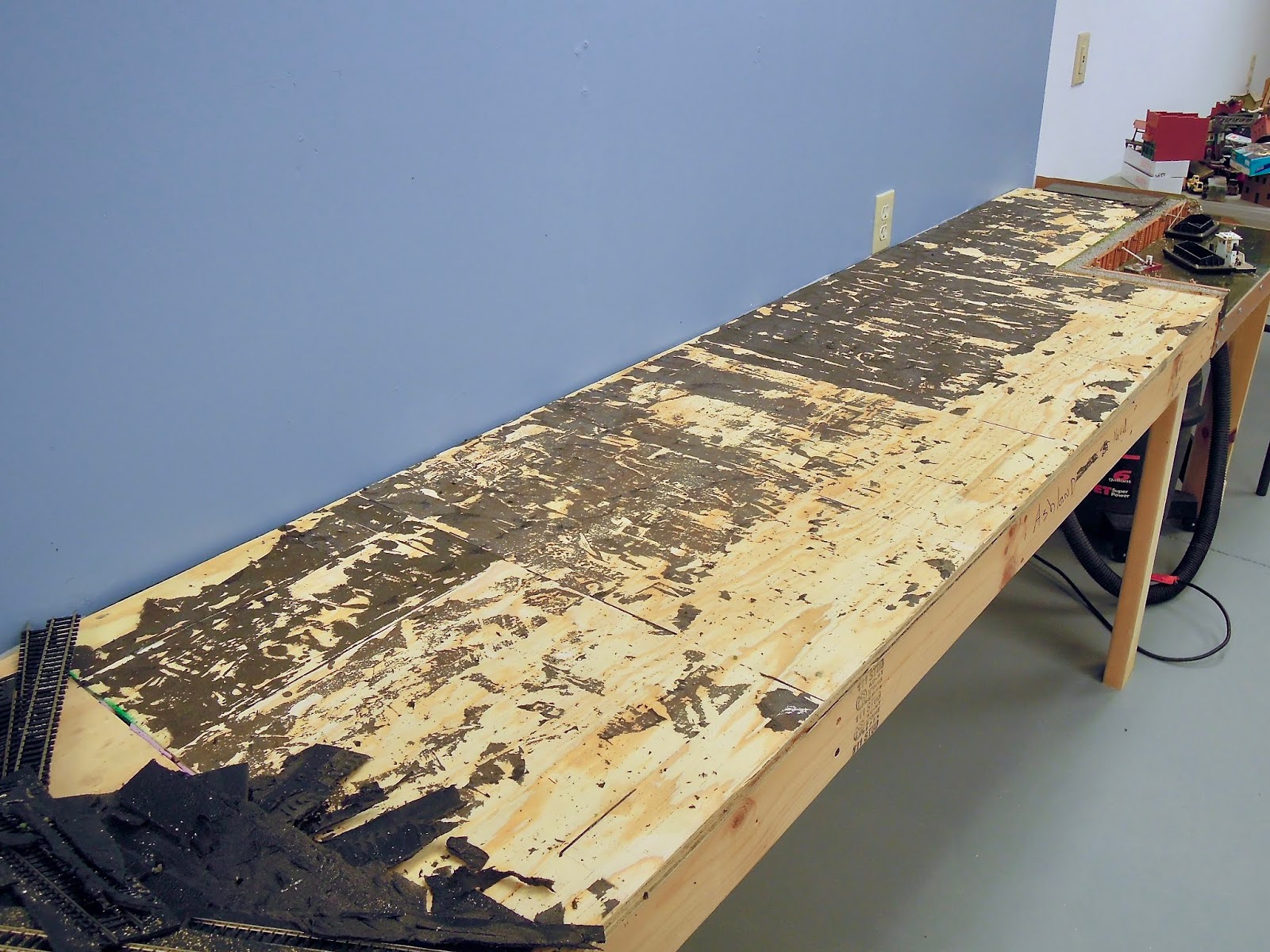
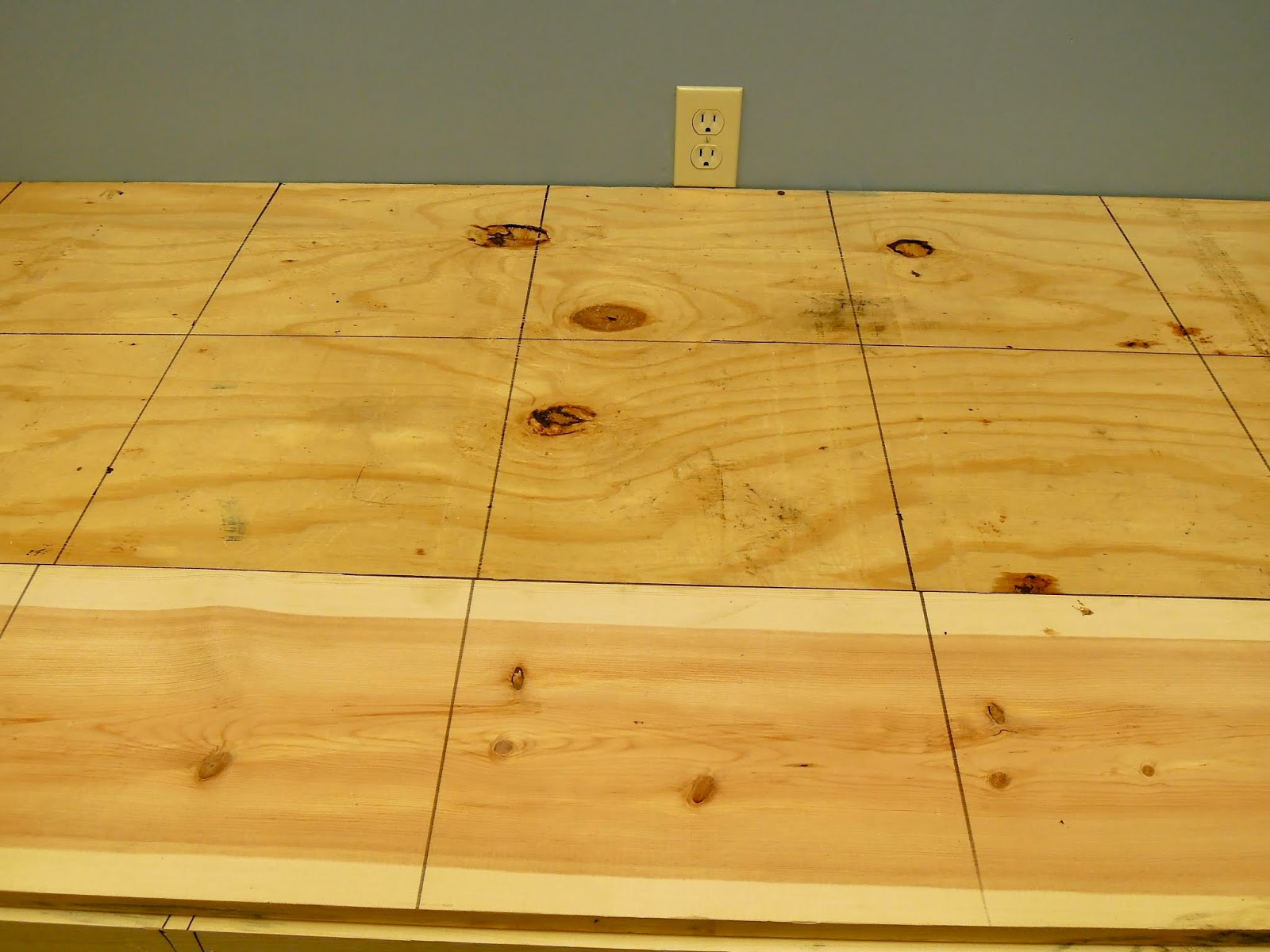
Spent some time in the train room today. I removed the track, turnouts, and roadbed from the 2x 8 section that will be primarily the staging yard. It's smoother than it looks, and is ready for roadbed and track. I still have to develop the track plan for this section.
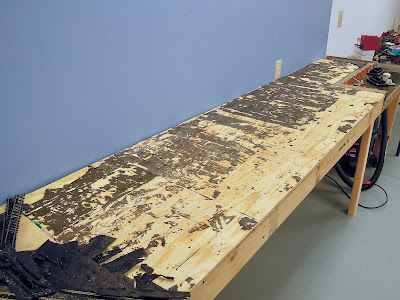
Next, I drew the the 1-foot square grid work, which coincides with the track plan I am following. As a reminder, I am following the "Tar Branch", the 2018 project railroad in Model Railroader .


Two members of our Thursday night round robin group have given up their nights so that the gang can come and help do the wiring under the benchwork. This means I have to have the roadbed and track down before the last Thursday of the month. But before that, I need to select the twenty best pieces of three-foot flex track from my stash of new and used track; I also need to inventory the available turnouts. All that needs to be weathered with Micro-Engineering track weathering solution. Plenty to do over the next three weeks; it's doable, but I'll have stay at it. Hopefully, trains running within a month.
Next, I drew the the 1-foot square grid work, which coincides with the track plan I am following. As a reminder, I am following the "Tar Branch", the 2018 project railroad in Model Railroader .

Two members of our Thursday night round robin group have given up their nights so that the gang can come and help do the wiring under the benchwork. This means I have to have the roadbed and track down before the last Thursday of the month. But before that, I need to select the twenty best pieces of three-foot flex track from my stash of new and used track; I also need to inventory the available turnouts. All that needs to be weathered with Micro-Engineering track weathering solution. Plenty to do over the next three weeks; it's doable, but I'll have stay at it. Hopefully, trains running within a month.
Subscribe to:
Posts (Atom)