Saturday, August 14, 2021

Remember ... hit enter !

Start with that absolutely nothing about a computer or computing is intuitive to me. Add to that the fact I can read and usually follow not-too-complex instructions. So the scene is set.

After a year's absence due to a serious case of procrastination, I finally returned to the railroad room to start work again on the Paducah Switching layout. Following two days of cleaning, discarding, setting up the work bench, and putting things away, I turned to installing fascia, and then, the second NCE throttle. Fascia installation went well, with good friend Don Loso stopping by and assisting with holding and clamping Masonite strips. And the installation of the two throttles, likewise went fine ... the primary worked just like it was supposed to, capturing engine addresses ... horns, lights, everything. I then carefully measured the distance between the two throttle insertion points to eleven feet (the auxiliary throttle conveniently comes with a twelve-foot connecting cable), drilled the necessary holes, and attached the face plates. I even got down under the benchwork -  with significant effort and even some pain - and strung and attached the connecting cable, as per directions.

Back in an upright position above the benchwork, I anxiously plugged in the auxiliary throttle, and ... nothing. Nada. Bumkus. Oh, the LED message window in the throttle lit up, but it would not accomplish any functions. No engine address capture, no horn, no lights, etc. Let's see, where are those directions? Do I remember something about the throttles also each having an address ... and did it say each had to have its own unique address? Ah, here they are, and yes, each throttle has to have a unique address and there are the four simple steps to set them.

Went through the four steps. Nothing. Maybe I hit a wrong key with my fat fingers. Do it again, more deliberately this time. Give it a try. Again, nothing. Thirty maddening minutes of reversing cables, exchanging throttle hookups, and every conceivable iteration I could think of, all with the same results ... nothing.

Next I did what I always do when I'm at my wits end on the railroad, call David James in Cleveland. David, readers of this blog will remember, is a dear friend, my model railroad mentor, and a devotee of the NCE system. Reached David ... he is on his way to a Chris Stapleton concert and off the top of his head, can't help me without the instruction book to check. But he does give me the phone number for Lee, from whom I purchased the system, and who is the absolute guru about all things NCE. Called Lee, got his answering machine. By now, I'm late for a dinner gathering with the neighbors, so shut everything down and left for dinner.

it was on the short drive to the restaurant and still thinking of the previous hour's frustrations, that a thought occurred: the throttle has an "enter" button, which I never pushed. The simple directions did not say "hit enter" and I didn't. I wonder ...

Returning home to a ringing telephone, it was Lee. I explained all that had gone on, adding the "enter" issue and asked if that could be the problem. He thought yes, told me go down and try it, and to call back if I still had problems. Went downstairs, turned everything on, carefully went through the four steps outlined, AND HIT ENTER.

SHAZAM!!! It works fine. Now on to non-computer stuff, like putting down ground cover, and building scenery, and running trains, and ... 

Tuesday, September 22, 2020

Rewards for great modeler

It's always good when an outstanding modeler is recognized. Such recognition is coming fast and furious to Dave Abeles, a good friend who models the Onondaga Cutoff, a mid-1990's HO-scale mythical Conrail-based railroad that circles Syracuse, New York.

Dave's latest honor comes in the form of the cover and a feature article in the September 2020, issue of Railroad Model Craftsman. Both the writing and photography are his. This adds to his earlier recognition in Model Railroader.

He is employed by the New Jersey Transit railroad, and is a graduate in engineering from Syracuse University. An outstanding modeler and photographer, Dave has a book in production with Kalmbach books, Signals and Interlockings for your Model Railroad, due out in the spring.

Heavy into operations and an innovator, Dave conducts virtual operating sessions on a monthly basis that include remote operators and dispatching from as far away as Scotland and Australia.

You can check out his modeling and railroad at https://onondagacutoff.blogspot.com.


Sunday, July 5, 2020

Populating with rolling stock

With the electrical work underneath the bench work done, at least until and if I decide to light building interiors, it's time to determine staging yard capacity. Today, I started adding the cars I have, one at a time, and using the engines to back them into place. This process served to check the needed rolling stock and track maintenance as well as capacity.


I found out at least three things. One, I have more rolling stock than will comfortably fit the layout. That's not a bad thing ... I can narrow down to the better running cars, and I can keep the others to change out periodically. Two, the rolling stock needs some serious maintenance including proper weights, coupler height adjustment, and metal wheels on some of the cars. Three, the track needs a little maintenance, but all in all, it's in pretty good shape.

It does seem, at first glance, the mix of cars (gondolas, box cars, hoppers, and tank cars) is about right for the planned industries they will serve.

Next on the agenda is to create the work bench area so I can have modeling space. Next item on the railroad - along with the items listed above - is the creation of the scrap yard.

Monday, June 1, 2020

More kudos

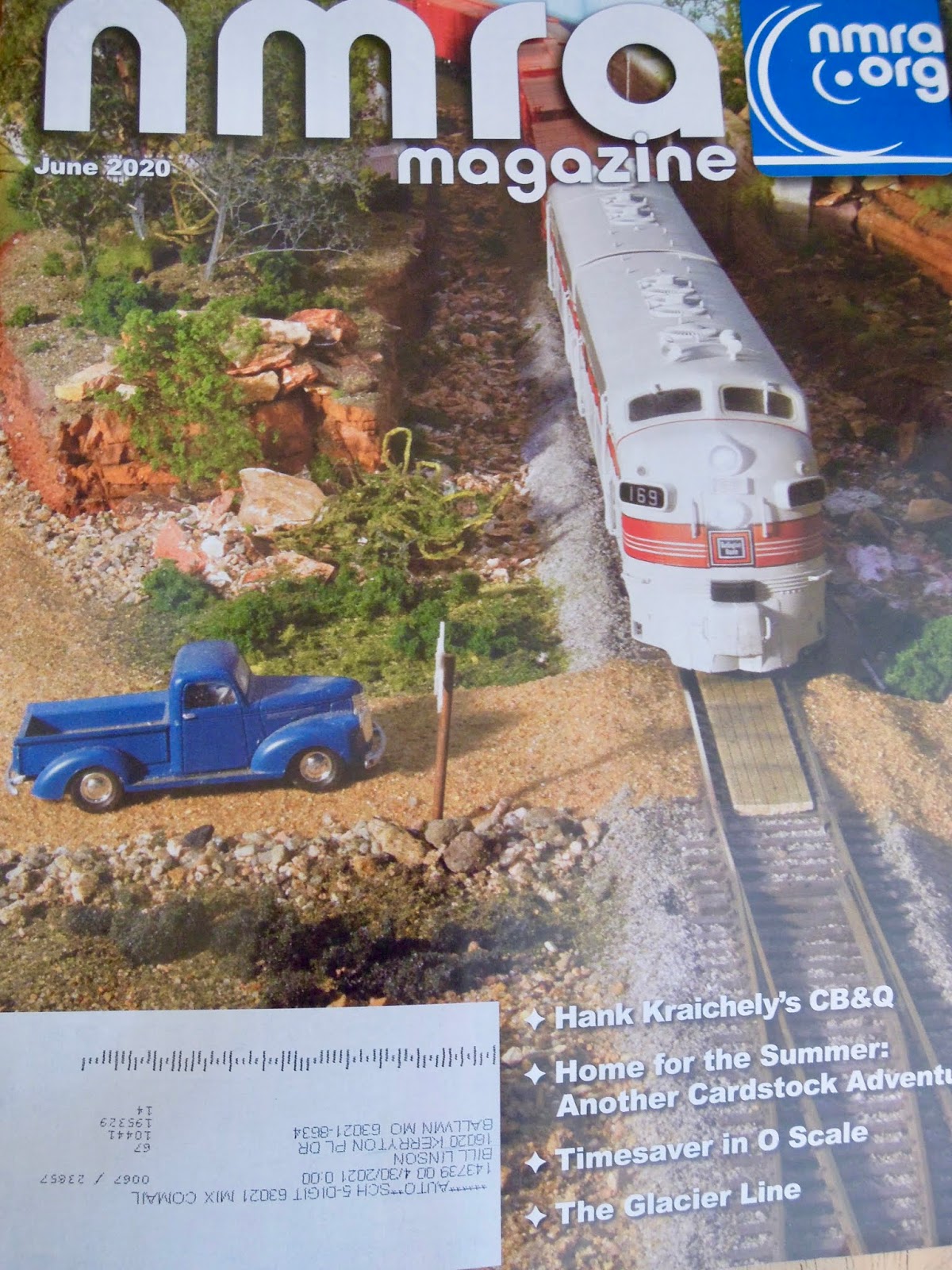
Even though the NMRA 2020 national convention has been scrubbed, some more of our local modelers (see the post of March 20, in this blog) are seeing their work published in the model press. Latest to be recognized are Hank Kraichely and John Peluso.

Hank Kraichely built a large homage to the Chicago, Burlington, and Quincy (CB&Q) between St. Louis and Hannibal in his 35' x 35' basement.  That effort ... his second at what he calls a "real" model railroad ... led to the cover of the June 2020 issue of the NMRA Magazine and the feature story inside.

This second iteration was started in 2004, and featured scenes include a long bridge over the Missouri River, and the Portland Cement Plant. A portion of the railroad is double-decked, without a helix, but rather with the long, gradual grade.

Conceived and built for realistic operations, Hank's thoughts, planning, methods, products, and results are carefully documented in the story. An operating session utilizes 10-12 operators, using wireless throttles on the Digitrax-powered layout.

Hank has held a number of NMRA related offices, the most recent as President of the Mid-Continent (MCoR) Region.


In an article written and photographed by Patrick Hiatte in the June 2020 issue of Model Railroader, the St. Louis-San Francisco Ry. (Frisco) layout of John Peluso is highlighted. The 16' x 30' double decked railroad is controlled by the CVP EasyDCC system, is set in the late '50s to the late '60s, and includes many prototypical scenes between St. Louis and Springfield. John is also into operations, and his four operating sessions each year use seven operators.


Friday, May 8, 2020

New Acquisitions

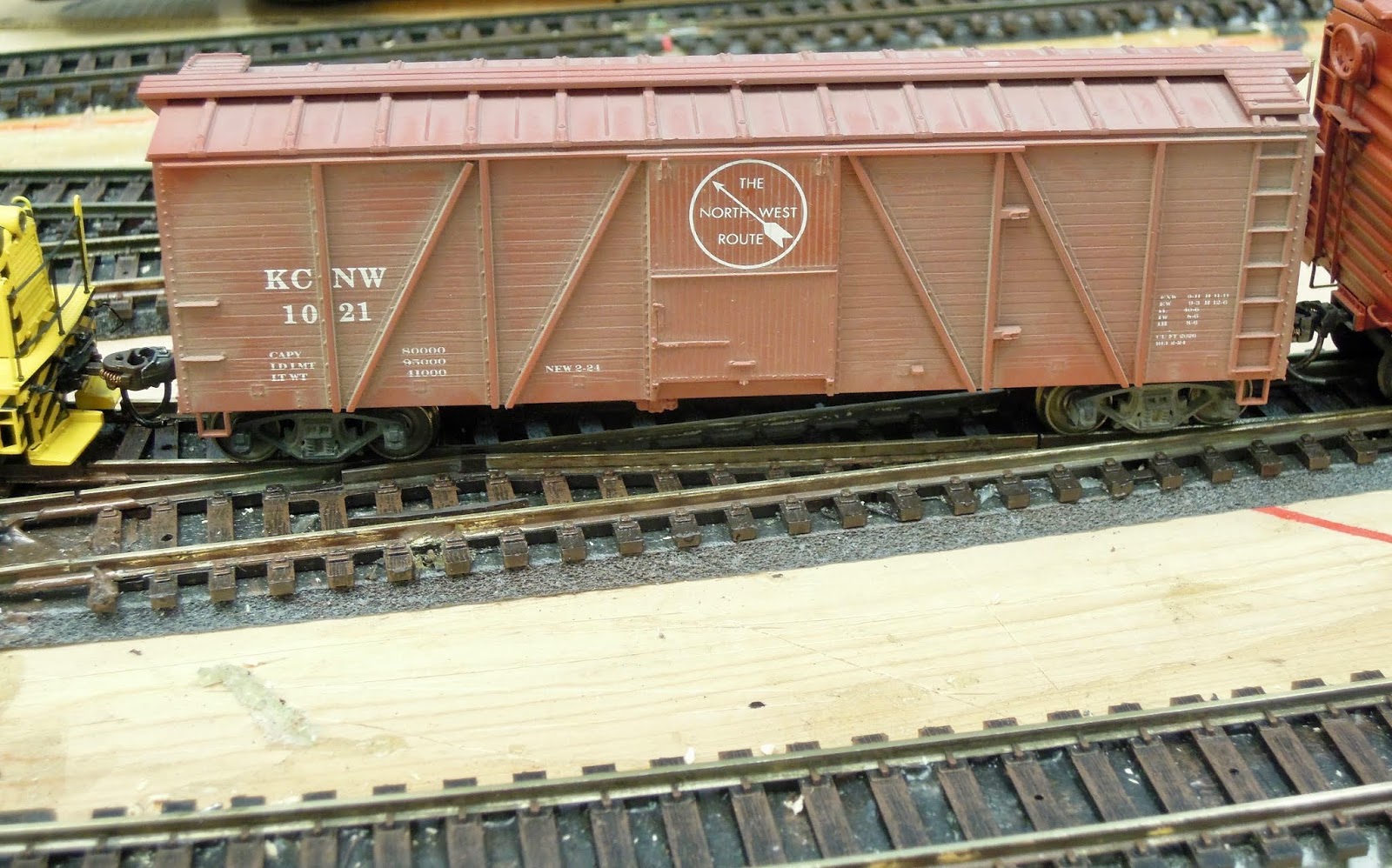
Three new acquisitions showed up on the Paducah Switching railroad today. All three came from the Kansas City Northwestern layout of the late Dick Wegner.

Dick was an outstanding modeler and this boxcar will fit well on the P&LE.

This 45-tonner came complete with a decoder. I envision it switching the scrap yard and coal dock.

We all miss Dick, but I am pleased he will always be a part of the Paducah Switching layout.
Dick was a devout fan of the Santa Fe and a member of that famed railroad's historical society. He was a regular attendee of the society's annual meetings, regardless of location.

Friday, April 24, 2020

Making a minor change

While in the process of soldering the last few electrical drops on the layout, I decided to make a minor change in a couple of structure locations.
New locations for scrap yard (lower left) and engine
house (upper right)
I'm moving the engine house from its previous location near the wall to the outside of the layout near the harbor. The scrap yard that was in that spot replaces the engine house near the wall. Reasoning behind this move is that the engine house will have a detailed interior, more easily seen near the aisle, while the scrap yard will still be quite visible in its new placement.

Drops are nearing completion, with the final few connections to follow. I'm getting anxious to get that complete, so I can start on scenery and structures. For those who are interested in such things, the drops are 22 ga wire connected to 16 ga buss wires underneath the layout. Connections are made by 3M Scotchlock
"suitcase connectors". Track for the layout is all Atlas Code 100 Flextrack on Woodland Scenics N-scale foam roadbed. Turnouts are medium by Peco, and are operated by Caboose Hobbies ground throws. It's open grid, and all on 3/4" plywood, built just 30" off the floor so I can operate it from rolling around on an office chair. Virtually everything - bench work, track, turnouts, most rolling stock, two of the four engines, a few structures, and even some wiring were repurposed from my previous layout. Power for the layout is NCE Power Cab, and that is completely new and a change from Digitrax.

Friday, March 20, 2020

Shout Out ... and kudos

I want to take this time and space to recognize some of the many outstanding modelers in the St. Louis area. The following have been featured in major model railroad publications -- five of them with cover photos in just the past few months. Admittedly, the 2020 NMRA Convention is coming to town, but that in no way lessens the work of these incredible modelers and their respective recognition by the modeling press.    
Eric Booman hit the twofer when his Utah Belt was featured on the cover of the December 2018 Model Railroader  and the December 2019 issue of the NMRA Magazine. The 22' 8" x 39' 6" layout is 40 years old, but evolving motive power, industries, operation, and scenery keep the railroad, set in northern New Mexico, in the present day. Eric has long been known for retiring motive power and bringing on new, concurrent with the prototype. One of the very few departures that Eric makes from the prototype is the absence of graffiti -- he abhors it and there is none to be found on the Utah Belt. Power for the layout is DC cab control.

The Utah Belt first appeared in the model press in 1978 with a feature in Railroad Model Craftsman, and Model Railroader recognized it first in 1986 and several times since then.

Although they didn't make the cover, a number of other accomplished St. Louis modelers were recognized in the
December 2019 issue of the NMRA Magazine. They include Brad Joseph and his HO layout; Dan McReynolds' HO scale ATSF Railway; Randy Meyer's Sn3 Canyon & Rocky Mountain; John Schindler (see below); John Peluso's HO railroad; Pete Smith's exquisite Sn3 1930's Loon Lake Railway & Navigation Co. layout featuring a number of geared locomotives; Doug McCormick's HO Union Pacific; and Ken Kroschwitz's monster HO layout at his hobby store.

All of the model railroads in this post will be on the Layout Tour at the convention, and several of the modelers will be among the dozens highlighted in the clinic offerings.


John Russel models the Rock Island railroad in O scale with his Rock Island Lines, and is the featured cover subject in the  March 2020 issue of Railroad Model Craftsman. Set in the 1948-1952 era, the railroad fills a 65' x 35' basement. Motive power is largely custom-painted brass imports, and to understand the level of prototype accuracy, one only has to know John worked as a trainman on "The Rock" for more than 40 years. John is well known nationally in O-scale circles, and his railroad has also been featured in Narrow Gauge and Short Line Gazette  on several occasions.

John's railroad is DC powered.


Gary Hoover is, along with Eric Brooman, one of the most recognizable names in model railroading. His latest effort is the cover subject for the April 2020 issue of Model Railroader. The 24' x 49' Norfolk and Western of the 1950s is set in Appalachian coal country and is unique in that it includes scenes in HO scratch built models of pictures by famed railroad photographer O. Winston Link. It replaces the ATSF Railway by Gary that was featured in a 2005 issue of Model Railroader. Prior to that railroad, he built the Missouri, Kansas, and Quincy. In addition to the covers, Gary has written many articles, and provided the photographs, for numerous national modeling publications.

This latest effort is DCC powered by Digitrax.

Gary Gross is the guru of the Franklin Pacific Railroad, a three-level HO layout set in 1958. It is the cover photo and featured article in the January 2020 NMRA Magazine. All compacted into a 12' x 20' footprint, the railroad is heavy on operations. The single set of staging tracks represents both ends of the layout: St. Louis on the east and Springfield/Kansas City on the west. As I said, Gary is devoted to operations: he uses a 4:1 fast clock, and the optimum crew is seven. Two to run Franklin Yard, a dispatcher who sits away from the railroad, and four running the trains.

Control for the Franklin Pacific is DCC.

Dave Roeder by any criteria, is a prolific award-winning modeler. His Webster Groves & Fenton Railroad is a prototype/freelance HO scale model railroad set in the mid-1980s with first and second generation diesels providing a bulk of the power. The layout is built as an operating railroad and has entertained monthly operating sessions continuously since 1996. Dave's FG&W is the cover photo and feature in the March 2020 NMRA Magazine. The layout occupies a 30' x 70' room.

Dave has won hundreds ... even thousands of awards ... in modeling, and not just in railroading. He is also a award-winning modeler of automobiles in different scales

The Webster Groves & Fenton is powered by analog DC.

John Schindler and his large St. Louis Junction railroad features action on both sides of the Mississippi River. The 30' x 60' layout was featured prominently in the March 2020 Model Railroader. It's a current era, multi-deck walk-in railroad with a mainline run of 275 feet. Crews use 40 locomotives to move some 500 cars in a typical operating session. A crew consists of eight to twelve operators, and the dispatcher uses a computer and CATS signal logic. The railroad is a Digitrax DCC layout. John is co-chair of the 2020 NMRA National Convention in St. Louis.

Featured on more than one occasion over the last several months in the NMRA Magazine  is David Lowell and his scratch-built structures and rolling stock memorializing the Chicago and Illinois Midland. His modeling is such that you will be hearing more about him in the coming months.

There's a lot of great modeling going on in the St. Louis area. This is just a tip of the iceberg.